

Selling a Used Car Privately in Ireland: The 2026 Checklist
Updated 14 November 2026
Selling a car privately in Ireland is straightforward if you take it in order: confirm you can sell it, prepare the paperwork, write an honest ad, let the buyer inspect the car, take payment safely, and register the change of ownership. This is a 2026 checklist, not legal advice. Official procedures can change. Vehicle ads on SellOrSwap are free to post for now and are checked by our team before they go live. Browse current ads in Cars & Motors while you prepare yours.
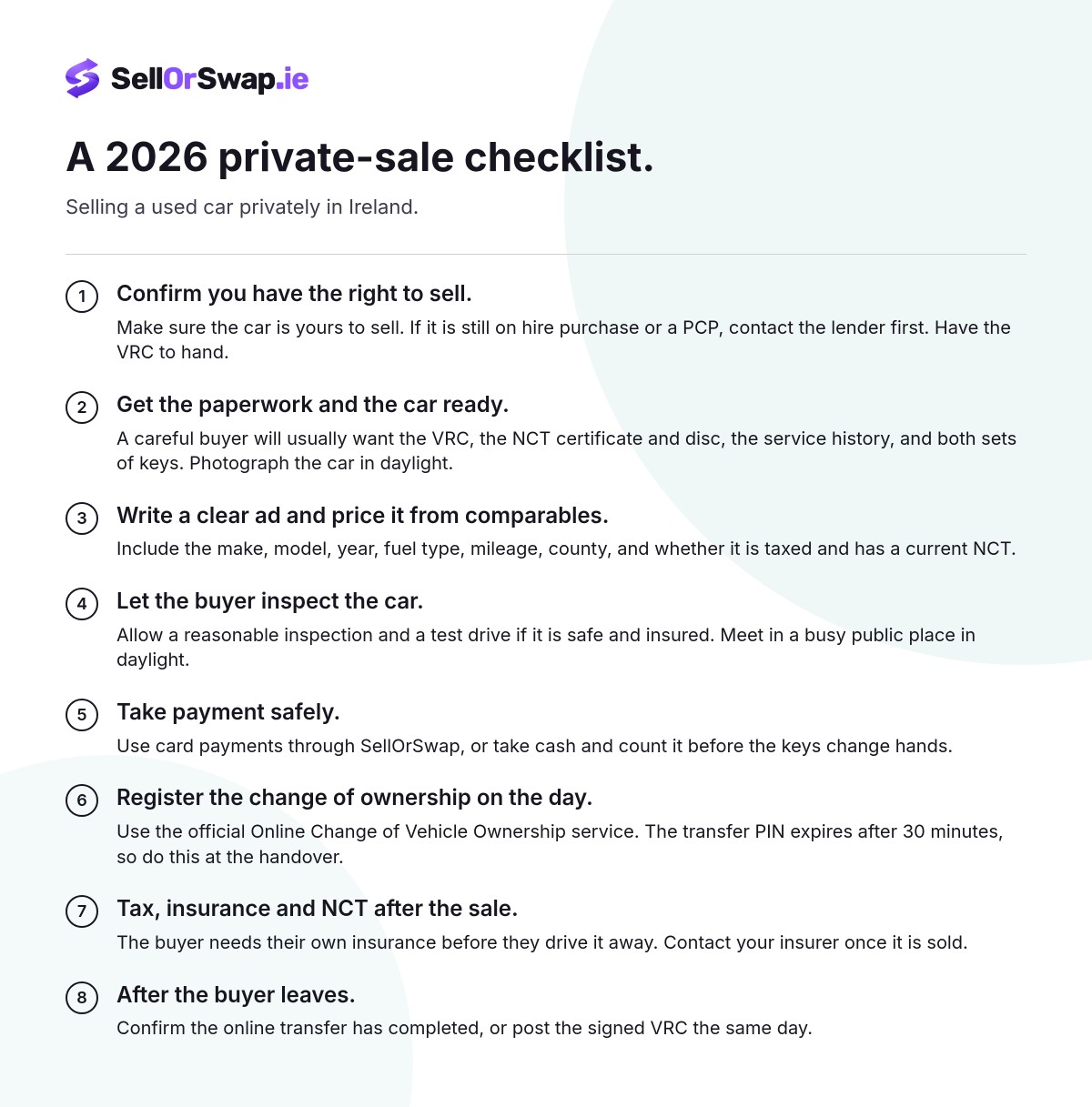
1. Confirm You Have the Right to Sell
Make sure the car is yours to sell before you photograph it. Citizens Information tells buyers to ask whether a car is still on hire purchase (HP) or a Personal Contract Plan (PCP). If it is, the finance company may still own it until the agreement is settled, so contact the lender first. Have the Vehicle Registration Certificate (VRC), or logbook, to hand: you need the registration and VRC numbers for the official online transfer.
2. Get the Paperwork and the Car Ready
A careful buyer will usually want to see the VRC; the NCT certificate and windscreen disc, if the car is old enough to need them; the service history, handbook and receipts, if you have them; and both sets of keys.
A valid NCT is not required at the point of sale: the Road Safety Authority (RSA) and the Department of Transport have been clear that a change of ownership does not itself require a test. A car over four years old generally does need a valid NCT to be driven on a public road, unless it is exempt. Private cars are first tested at four years, then every two years until the tenth anniversary, then annually; from 30 years they revert to every two years, and they are exempt from 40. The NCT is a basic safety check, not a warranty, so be honest if it is due soon or has expired.
Wash the car, tidy it, and photograph it in daylight, including the mileage, any damage, the service book and the NCT disc. The Competition and Consumer Protection Commission (CCPC) tells buyers to ask about crash history, mileage and outstanding finance. Answer honestly.
3. Write a Clear Ad and Price It From Comparables
Include the make, model, year, fuel type, mileage, county, and whether it is taxed and has a current NCT. Say if it has been in an accident, or if you do not know, and list extras such as spare keys or recent tyres.
Price it from similar live ads and, where you can see them, completed sales, comparing age, mileage, condition and location. Asking prices are not sale prices. Current car ads are on SellOrSwap, and a wider view of Irish car marketplaces is on our DoneDeal car alternatives page. This guide does not quote sample prices. Vehicle ads are free to post for now; card-payment fees are on the Pricing page.
4. Let the Buyer Inspect the Car
On a private sale, the CCPC says consumer law does not protect the buyer in the same way as a purchase from a dealer. Buyers are told to have a mechanic inspect the car, and you should allow a reasonable inspection and a test drive if it is safe and insured. Meet in a busy public place in daylight, and do not be rushed.
The Department of Transport's online service also lets a buyer check make and model, colour, tax status, test status, previous owners and whether the car was imported. Compare the NCT certificate and disc with the odometer: Citizens Information notes that previous readings appear on the certificate, and the latest is on the disc. If the disc shows a higher figure than the dashboard, that is a warning sign.
5. Take Payment Safely
Agree the price in the app before the handover. Use card payments through SellOrSwap, where the money is held until handover is confirmed, or take cash and count it before the keys change hands. Card payouts are released at the handover and usually reach your bank about a week later. Do not hand over the car on a promised bank transfer, Revolut payment or screenshot, and never send text codes to anyone.
6. Register the Change of Ownership on the Day
Sellers and buyers are legally obliged to notify the Department of Transport when a vehicle changes hands. The record sits on the National Vehicle and Driver File (NVDF), and the registration itself is free. The usual method in 2026 is the Online Change of Vehicle Ownership service, at vehicleservices.gov.ie/cvo or through motortax.ie (or motarchain.ie in Irish). Citizens Information, edited 5 May 2026, sets out these steps:
- The seller goes online and enters the vehicle registration and the VRC number.
- A one-time transfer PIN is emailed to the address recorded for the owner on the NVDF.
- The seller shares that PIN with the buyer. It expires after 30 minutes, so do this at the handover, not the night before.
- The buyer enters the PIN and signs in with a verified MyGovID, which they should set up before they arrive.
- The buyer confirms they are taking ownership.
- Ownership is transferred, and a new VRC is posted to the buyer. The date of sale recorded is the date the transaction was processed online.
The seller can then be satisfied the car is no longer in their name, and the buyer cannot tax it until the change has been processed.
You can still complete the change by post: both of you sign the back of the VRC, and the seller sends it to the Department of Transport, Driver and Vehicle Computer Services Division, Shannon, Co. Clare. Citizens Information says a posted VRC usually takes about two to five days to process once received. Pre-1993 vehicles use Form RF200, and sales to a motor dealer use Form RF105.
7. Tax, Insurance and NCT After the Sale
Motor tax. Selling a car is not listed by the Department of Transport or Citizens Information as a reason for a motor tax refund. Refunds on Form RF120 cover cases such as a vehicle being scrapped, stolen and not recovered, permanently exported, or unused because of illness or absence from the State. If you are unsure about time left on the disc, ask your local motor tax office or check motortax.ie.
Insurance. By law, a driver must have motor insurance to use a vehicle in a public place. Cover does not automatically follow the car, so the buyer needs their own insurance before they drive it away. Contact your insurer once it is sold; whether a refund is due depends on your policy.
NCT. A change of ownership does not itself require a new test. The new owner must keep any required certificate up to date if they use the car on the road.
8. After the Buyer Leaves
Confirm the online transfer has completed, or post the signed VRC the same day if you used the postal route. Tell your insurer, mark the ad as sold, and keep a record of the price, date and chat. Later queries can go to motortax.ie, the Driver and Vehicle Computer Services Division on 0818 411 412, or Gardaí if a crime may have happened.
FAQ
Do I have to get an NCT before I sell?
Not automatically. A change of ownership does not require an NCT check. A car that needs a test should still have a valid certificate if it will be driven on a public road.
Can we transfer the car online at the handover?
Yes. The transfer PIN expires after 30 minutes, and the buyer needs a verified MyGovID, so set that up before you meet. If they do not have MyGovID yet, the postal VRC process is the alternative, but it is slower. Do not leave the paperwork unfinished.
Does unused motor tax come back to me?
Selling a car is not listed as a reason for a refund on the official Department of Transport or Citizens Information pages. Check with your local motor tax office.
Are vehicle ads free on SellOrSwap?
Yes, they are free to post for now. Card-payment fees and optional extras are on the Pricing page.